
Parallel Carbon is deploying Project Tsavorite in Kenya as part of Tencent's CarbonX Programme
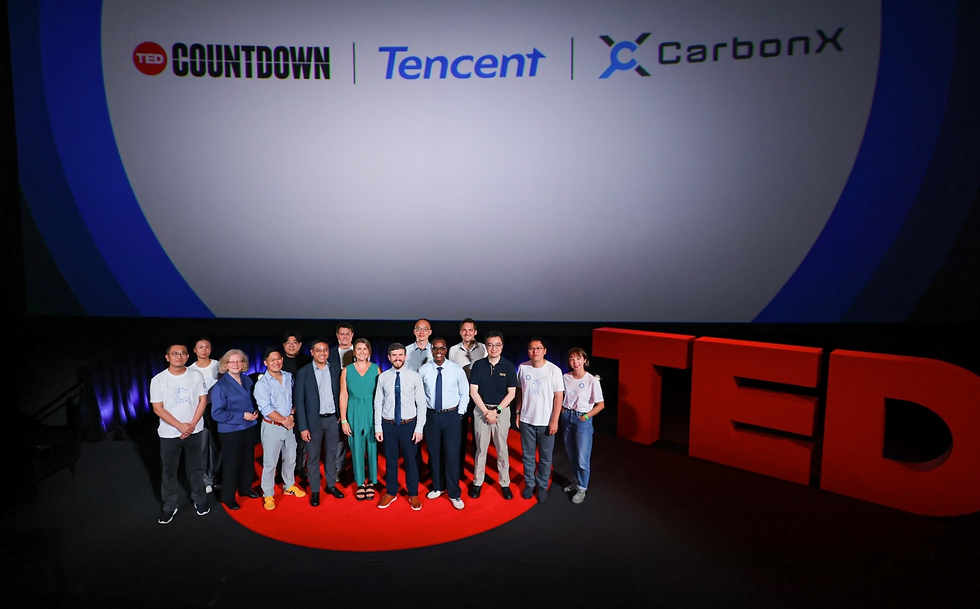
Parallel Carbon is proud to announce that we’ve been selected by Tencent's CarbonX 2.0 Programme to deploy a field demonstration of our technology. Building on the results of our Malachite pilot in Manchester, our system will be scaled up by an order of magnitude and deployed as Project Tsavorite in Kenya. This field deployment will test performance under real commercial conditions , demonstrating our technology in a real operating environment, with real offtakers, and a real industrial purpose.
What Malachite Proved
Our pilot plant in Manchester, Malachite, co-produces CO2 and hydrogen from air, water, and power. The warehouse-scale pilot employs an integrated process for water electrolysis and mineral processing, and it has demonstrated production rates exceeding 20 tonnes per annum of CO2 from air. Our small team of scientists and engineers built the R&D pilot with their own sweat and tears, operates it today, and has successfully pushed it to its limits to find its strengths and weaknesses.
"Malachite proves the technology at a relevant scale while providing a test platform for Parallel Carbon to improve performance through rapid iteration. Project Tsavorite in Kenya is where we put our learnings to the test and demonstrate the value of our unique system architecture."
About Tencent's CarbonX Programme
Tencent built CarbonX around a single uncomfortable truth: 75 percent of the solutions needed for global decarbonisation rely on technologies that are not yet ready to deploy. The programme exists to change that. From over 660 applicants across 54 countries, 50 finalists were named, and 16 winning teams were ultimately selected to receive almost US$30 million in catalytic funding, technical resources, and real-world pilot environments.

The CDR track is anchored in Kenya, with one explicit mandate: make permanent carbon removal scalable and affordable. It is the right place to prove a technology of this kind. Kenya's abundant renewable energy resources, its favourable geology for permanent CO2 storage, its growing industrial base, and the direct exposure of its communities to climate stress make it a credible and meaningful deployment environment, not a symbolic one.
"Parallel Carbon was selected for that track, and we intend to take it one step further. We will not just remove carbon from the air, but will sell clean molecules to local industry. In effect, we will be cleaning the air while powering the Kenyan economy."
What the Kenya Project Actually Means
Scale matters. Demonstrating that a technology works at 20tpa CO2 in Manchester is one thing. Field testing it at ten times that scale, in East Africa, with genuine industrial offtakers in place, is something different. It is the difference between demonstrating technical feasibility and demonstrating a pathway to commercial deployment.
The Kenya deployment will generate provable climate impact. Carbon removal that is measured, verified, and permanent. Green hydrogen produced from renewable power at a cost structure designed to undercut fossil-derived alternatives. And critically, a platform that demonstrates what affordable, secure electrification of industry can look like for a continent that has too long been underserved by the energy transition.
We have all watched energy markets absorb the shockwaves of conflict, supply chain disruption, and geopolitical volatility. Every disruption is a reminder that dependence on imported fossil fuels is not just a climate problem, but a strategic liability. Technologies that produce clean molecules locally, from abundant renewable power, are increasingly becoming critical infrastructure for a resilient energy transition. Kenya is an opportunity to show what that infrastructure looks like when it is actually built.
Beyond Parallel Carbon
Our mission is to build the world's most affordable, resilient supply chains for fuels and chemicals. Achieving that mission requires moving beyond controlled pilot environments and demonstrating performance under real operating conditions. It is served by a field deployment in Kenya, validated against real-world operating conditions, producing data that closes the gap between what climate technology promises and what it delivers.

The 'Valley of Death' between innovation and deployment is often framed as a funding problem. In practice, it is just as much a proof problem. Capital moves once there is evidence that a technology performs at scale, outside controlled conditions, with real buyers and real economic pressure attached. Project Tsavorite is designed to provide exactly that evidence.
For Kenya, a successful deployment creates something tangible: a replicable model for domestic clean molecule production that reduces energy import dependency, creates skilled technical employment, and demonstrates that climate-vulnerable regions do not have to wait for the energy transition to arrive from elsewhere. It can be built here.
What Comes Next
We are grateful to the Tencent CarbonX team for their rigour in selecting projects and their genuine commitment to real-world impact over theoretical promise. If you are working on offtake, project development, policy, or financing in East Africa's clean energy and industrial decarbonisation space, we want to hear from you.
The demonstration is underway. The scale is real. The impact is measurable. The next challenge is proving that affordable carbon removal and clean molecule production can succeed at scale, in the environments where they are needed most. Kenya is where we begin.


The post on Parallel Carbon deploying Project Tsavorite in Kenya as part of Tencent's CarbonX Programme highlights the growing role of climate technology and cross-border partnerships in addressing environmental challenges. I appreciate how this initiative demonstrates the potential for private sector collaboration to advance carbon reduction goals. A project management course & workshop for managers in Nairobi, Kenya could equip leaders with the skills needed to coordinate complex climate projects, manage stakeholder expectations, and deliver measurable environmental outcomes.
Parallel Carbon deploying Project Tsavorite in Kenya as part of Tencent's CarbonX Programme is a compelling example of how global technology capital and local environmental expertise can combine to deliver carbon solutions with genuine ecological and community impact. For executives managing complex, multi-stakeholder projects like these, the project management seminar & course for executives in Nairobi, Kenya offers the end-to-end delivery frameworks and stakeholder management tools needed to execute ambitious sustainability projects with genuine precision and organizational depth.